


 News





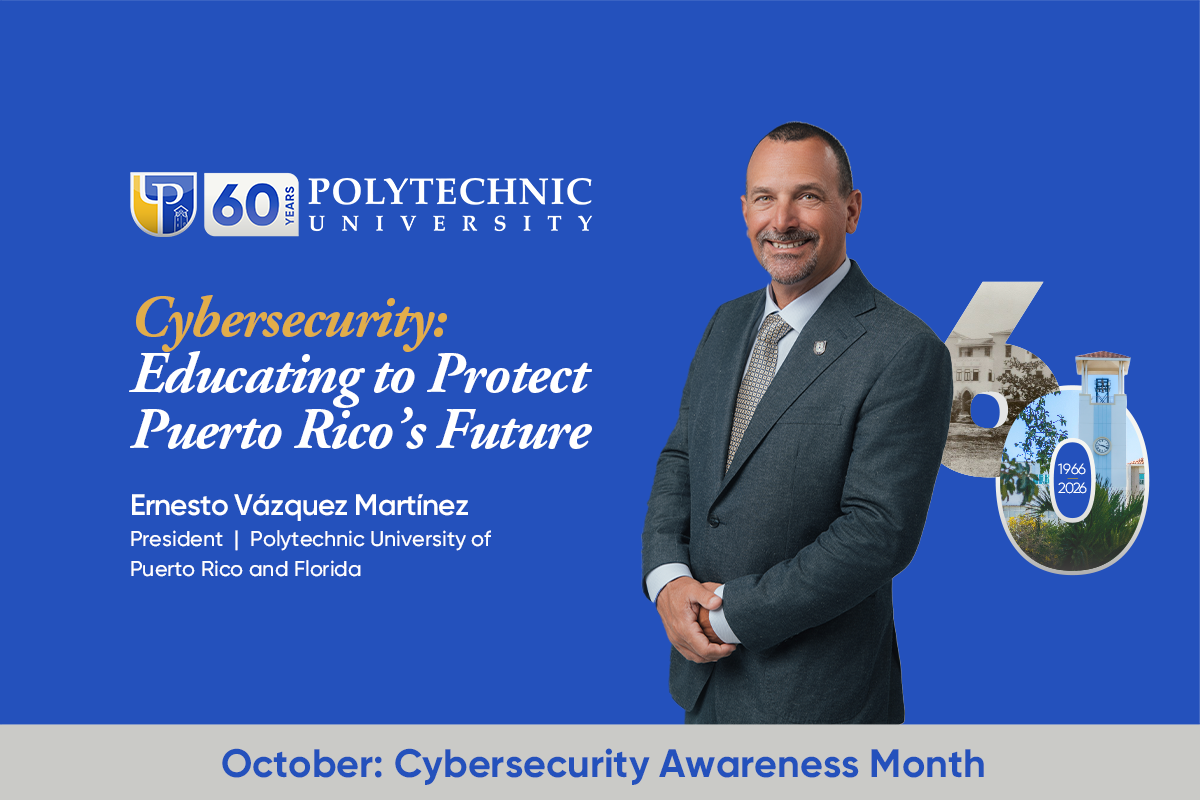
By Ernesto Vázquez Martínez
President
Polytechnic University of Puerto Rico and Florida
A country’s security is no longer measured solely by the strength of its institutions, its physical infrastructure, or its economic capacity. Today, it also depends on its ability to protect the information, technological systems, and digital services that sustain its operations.
A cyberattack can disrupt hospital operations, compromise financial institutions, paralyze government services, and affect businesses that are essential to our economy. This reality compels us to recognize that cybersecurity is no longer exclusively a technological issue; it has become a strategic national priority.
Every October, we observe Cybersecurity Awareness Month, an initiative that promotes awareness, prevention, and digital security best practices. However, this month must represent much more than an educational campaign. It must become an opportunity to reflect on how we are preparing Puerto Rico to address risks and seize the opportunities presented by an increasingly digital economy.
The answer begins with education and the development of specialized talent.
Higher education is the first line of defense. Artificial intelligence, automation, cloud services, and interconnected systems are transforming our industries. These advances drive productivity and innovation, but they also create threats that require increasingly specialized knowledge.
Moreover, the nature of the threat is changing. Traditional cyber defenses were designed to confront human attackers; today, they must respond to artificial intelligence agents capable of carrying out complex operations with progressively less human intervention. In November 2025, Anthropic documented a cyberespionage campaign targeting approximately 30 organizations in which it estimated that AI performed between 80% and 90% of the operations. Meanwhile, in September 2026, Unit 42, Palo Alto Networks’ threat intelligence and incident response team, reported an intrusion in which AI agents performed tasks in less than ten hours that would have required approximately two weeks of human work. These incidents demonstrate a decisive shift: attackers are not only expanding their capabilities but also reducing the time available to detect and contain their operations. The response requires evolving toward defenses capable of anticipating and responding to threats that operate at machine speed.
These agents operate at machine speed and do not require the expertise of an elite team. A defense designed to operate at human speed will be too late. Businesses, governments, and organizations must prepare comprehensively by implementing automated detection and response, defensive AI, strict controls over credentials and the AI agents they adopt, and thoroughly tested business continuity plans. Booz Allen estimates that most of the models it evaluated could achieve fully autonomous attacks within approximately six months.
Acquiring technology alone is not enough. We need professionals capable of anticipating risks, identifying vulnerabilities, protecting critical systems, and responding swiftly to cybersecurity incidents.
In 2009, the Polytechnic University of Puerto Rico and Florida became the first university in Puerto Rico to receive the federal designation of Center of Academic Excellence in Information Assurance Education, awarded through the U.S. National Security Agency (NSA) and Department of Homeland Security (DHS) program.
Currently, the University’s recognition as a National Center of Academic Excellence in Cyber Defense (CAE-CD) remains valid through 2027 under the federal program administered by the NSA.
This distinction reflects a longstanding commitment to preparing professionals equipped to confront complex digital threats.
However, recognition also brings responsibility: to continue innovating and connecting learning with the real-world needs of the professional environment.
Our island has an opportunity to strengthen its position as a hub for technology talent development, innovation, and specialized services.
Achieving this goal requires closer collaboration among universities, private businesses, government agencies, and professional organizations.
Cybersecurity demands investment, applied research, continuing education, and hands-on experiences for our students that align with market needs.
Furthermore, the responsibility for protecting our organizations does not rest solely with technology specialists. Business leaders, government officials, and professionals across all disciplines must cultivate a culture of prevention and digital responsibility.
An organization may have advanced technology, but without the talent and leadership necessary to protect it, it will remain vulnerable.
During this month, we reaffirm the Polytechnic University of Puerto Rico’s commitment to contributing to the development of skilled professionals, technological innovation, and strategic partnerships that strengthen Puerto Rico’s digital resilience.
The real challenge is not simply to defend ourselves against today’s digital threats, including autonomous AI agents. It is to develop the human, technological, and institutional capabilities needed to confront threats we have yet to encounter.
Puerto Rico cannot aspire to become a more innovative and competitive economy without investing in the security of its digital future. And that investment begins in our educational institutions.