







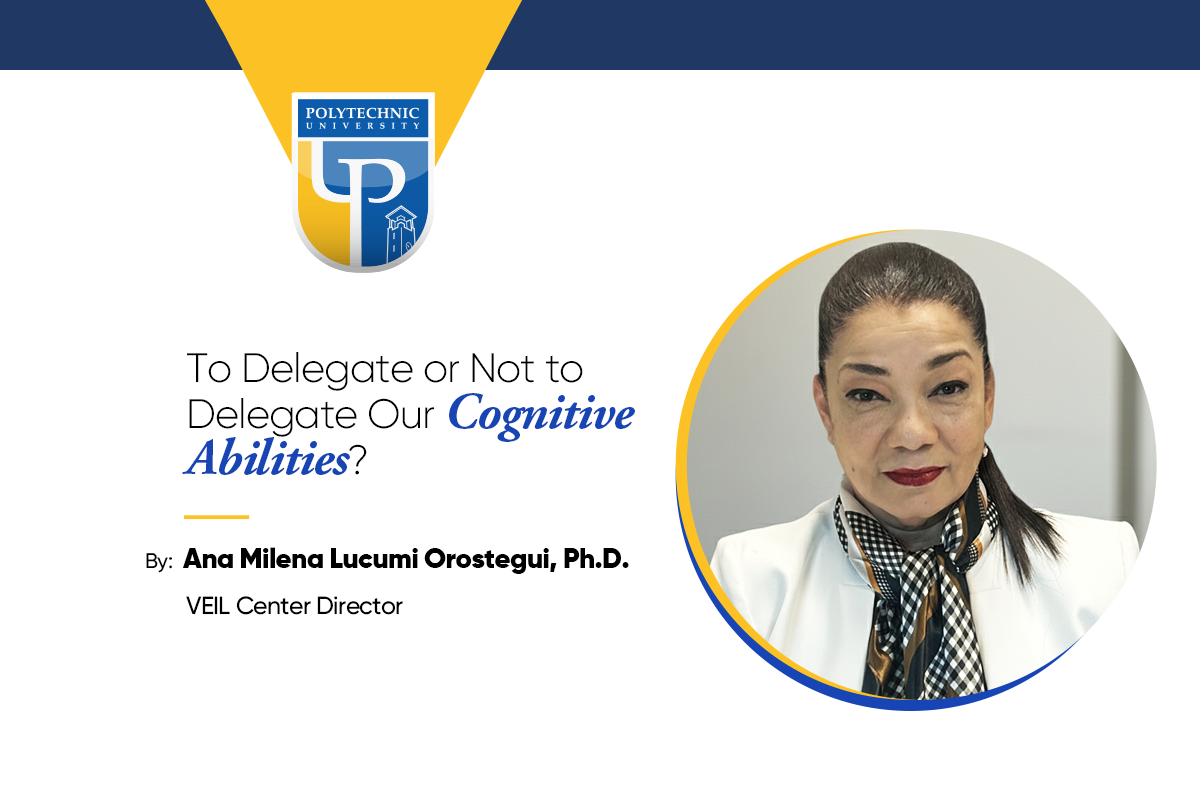
Is the human race today facing a threat born from its own intelligence? Could we be like other living beings that develop a capacity to adapt to survive environmental threats? In recent decades, we have discussed the concept of intelligence in various ways, correlating it with the theory of multiple intelligences and emotional intelligence. But a simple way to define intelligence is to quote Piaget (1952): “Intelligence is the highest form of adaptation that allows individuals to organize experience and progressively build cognitive structures”.
Throughout history, we have been called upon to use and develop our ability to adapt in each technological revolution that we ourselves caused. Our brains are designed to find solutions to complex problems, with a natural disposition to conquer the challenges of the world. The current call is to face the new challenge of activating our cognitive, cultural, and technological flexibility to adapt to the unstoppable advance of Artificial Intelligence (AI).
This new technological challenge, which has been socially widespread for more than three years, has been a phenomenon that changes everything (disruptive) and is unlike the technologies that preceded it. The difference lies in the fact that artificial intelligence is the first technology that mimics human cognitive functions and produces knowledge. In its technical execution, we observe that it generates, creates, proposes, synthesizes, and simulates, among other things.
It is not only groundbreaking, is recursive, because it designs and improves its own processes and produces tools that optimize AI itself. With these capabilities, AI accelerates its own development and penetrates all functional systems of society, impacting a variety of professions and trades.
As human beings, we have had the privileged position of being a species that generates high-level knowledge, abstract reasoning, and reflective consciousness. While we recognize the ability of some animals and systems to collectively generate solutions, there is a mental and emotional difficulty in recognizing the fact that there is potentially an algorithm superior to human intelligence.
At this point, it is necessary to pause and return to the premise that AI was created by a human being, and clearly, AI will be as good or bad as its creator.
As a society and as educators committed to social responsibility, we must deepen our awareness that the impact of AI is an important topic for discussion in terms of law, ethical parameters, and regulation. It will be necessary to seek a balance between AI’s speed and our slowness, managing technological anxiety and resisting the temptation to stop using our cognitive capacity. AI has the potential to affect us with a speed that contrasts with our level of social and cognitive flexibility.
Returning to the initial metaphor, we must, like other organisms, promote a state of cultural and technological evolution together (co-evolution). We must maintain decision-making about our creation, AI, while not losing the intrinsically human exercise of philosophizing about the fact that, for the first time, part of knowledge no longer comes exclusively from human beings, but from models trained with large amounts of data that we ourselves have captured throughout history.
New questions will continue to emerge in this symbiosis of intelligences about knowledge and learning outside the extraordinary human brain that could create something that surpassed it.
By:
Ana Milena Lucumi Orostegui, Ph.D.
VEIL Center Director
Polytechnic University of Puerto Rico
 News
News