Program Description
Program Description
This four-year program develops the required knowledge, skills, and dispositions to face the dynamics of technological environment in contemporary society. Throughout the program, theoretical and practical experiences are interwoven with socio-humanistic studies, mathematics, basic science, engineering science, and engineering design experience.
The design experience begins during the first year of studies with an introductory course in engineering design, which aims to develop students’ creativity and problem-solving skills. This focus on design continues throughout the curriculum culminating in a significant design experience within a final Capstone Course. Real-life complex engineering problems are defined and solved by integrating the fundamental elements of modern design theory, methodology and tools.
The Electrical Engineering Program offers two areas of interest: a) Smart Grid Power Systems, and b) Communications, Signals, and Controls Systems. The Smart Grid Power Systems area of interest prepares students for planning, design, and operation of centralized and distributed generation, smart grid transmission and distribution, and end-user electrical systems. The Communications, Signals and Controls Systems area of interest prepares students for the design of analog and digital electronics, industrial process automation and control, and wireless cellular communications networks. Students selecting the Smart Grid Power Systems area of interest are required to take twenty-four (24) credit-hours from the required area courses, and nine (9) credit-hours from a pool of elective area courses, for a total of thirty-three (33) credit-hours. Students selecting the Communications, Signals and Controls Systems area of interest are required to take eleven (11) credit-hours as required area courses, and twenty-two (22) credit-hours from a pool of elective area courses, for a total of thirty-three (33) credit-hours. The students set their educational objectives for Electrical Engineering when they select one of these main areas of interest.
Program Mission
Program Mission
To educate graduates with a broad background in computers, mathematics, science, and electrical engineering capable of performing successfully as electrical engineers and pursuing graduate studies.
Program Educational Objectives
Program Educational Objectives
Within a few years of graduation, the PUPR Electrical Engineering program graduates are expected to attain the following:
- Establish themselves as practicing professionals in PR or USA integrating rapidly to changing job demands and gradually obtaining leadership positions.
- Hold positions of increasing responsibility in an electrical engineering field or related area, demonstrating professional competence and ethical behavior.
- Contribute to their organization or discipline as an active member of a professional team or as a technical liaison in a bilingual (Spanish-English) environment.
- Continue their professional development through independent learning, involvement in advanced professional studies in electrical engineering or related areas or enrolling in graduate school.
Student Outcomes
Student Outcomes
By the time of graduation, students of the Electrical Engineering program at PUPR are expected to have attained the following:
1. an ability to identify, formulate, and solve complex engineering problems by applying principles of engineering, science, and mathematics
2. an ability to apply engineering design to produce solutions that meet specified needs with consideration of public health, safety, and welfare, as well as global, cultural, social, environmental, and economic factors
3. an ability to communicate effectively with a range of audiences
4. an ability to recognize ethical and professional responsibilities in engineering situations and make informed judgments, which must consider the impact of engineering solutions in global, economic, environmental, and societal contexts
5. an ability to function effectively on a team whose members together provide leadership, create a collaborative environment, establish goals, plan tasks, and meet objectives
6. an ability to develop and conduct appropriate experimentation, analyze and interpret data, and use engineering judgment to draw conclusions
7. an ability to acquire and apply new knowledge as needed, using appropriate learning strategies
Academic Load
Academic Load
The minimum full-time load per trimester is twelve (12) credit-hours. To register for sixteen (16) credit-hours or above, the student must obtain the approval of the department head and dean. Credits will not be awarded for courses in which the student is not properly registered.
Duration
Duration
The program’s format offers career-minded professionals the unique opportunity to earn a Bachelor of Science in Electrical Engineering in four years while continuing to work in their current positions. It is also suitable for full-time students who have the desire to commit to a more demanding academic schedule. The program may be completed in four years by enrolling in about eleven (11) to fourteen (14) credits per term.
Academic Schedule
Academic Schedule
Registration for all students is held prior to the beginning of each term on designated registration days, as stipulated on the Academic Calendar. Completion of registration for each term is required prior to class attendance. The academic year consists of three terms, and three summer sessions. One summer session for engineering courses, and two summer sessions for arts and sciences courses. Fall, winter, and spring classes are scheduled from 8:00 a.m. to 10:30 p.m., Monday through Thursday, and from 8:00 a.m. to 5:00 p.m. on Fridays and Saturdays. Students are required to make-up class contact hours lost because of holidays.
Career Opportunities
Career Opportunities
The alignment of the Electrical Engineering program with industry requirements assures that graduates of this program will remain in high demand. Today, our electric power industry constituents face challenges for providing an efficient and economical energy supply to satisfy increasing exigencies by applying traditional schemes as well as using smart power distribution and control technologies, and new alternative energy sources. Other constituents of the communication industry have also been undergoing sweeping changes (i.e., wireless technology, 5G-cellular, optic fiber, etc.), forever transforming people’s lives and culture. Increasing demands for efficiency, productivity, and multiple bottom-line goals in the modern enterprise require the smart application of automation, controls, and ubiquitous interconnectedness while preserving ethical, environmental, and humanistic goals. The demands of these and other related fields of human endeavor assure the availability of highly satisfying, high impact jobs for our well-equipped graduates in the foreseeable future.
Developmental Studies
Developmental Studies
All students that request admission and are admitted to the Electrical Engineering Program must show evidence that they have acquired the academic abilities and skills necessary to progress through this major. Those not demonstrating the complete acquisition of these abilities and skills will be required to take some of these developmental courses. Abilities and skills are demonstrated through the results of the College Entrance Examination Board Test, results of PUPR’s placement test, previous university experience, and other tests or criteria. The courses are designed to help students overcome deficiencies in languages, mathematics, and science. These developmental courses are in addition to the 150 credits of the Electrical Engineering Program. The courses are awarded their corresponding credits according to contact hours. The courses are the following:
Developmental Studies Component
(Maximum of 30 Credit-Hours)
| Course | Title | Credit Hours |
|---|
| ENGL 0100 | Preparatory English | 3 |
| ENGL 0110 | English Grammar | 3 |
| ESOL 0100 | Beginner English as a Second Language | 3 |
| ESOL 0110 | Intermediate English as a Second Language | 3 |
| ESOL 0120 | Advanced English as a Second Language | 3 |
| MATH 0102 | Preparatory Mathematics | 3 |
| MATH 0106 | Elementary Algebra | 3 |
| MATH 0110 | Intermediate Algebra | 3 |
| MATH 1330 | Precalculus I | 3 |
| MATH 1340 | Precalculus II | 3 |
Laboratories
Laboratories
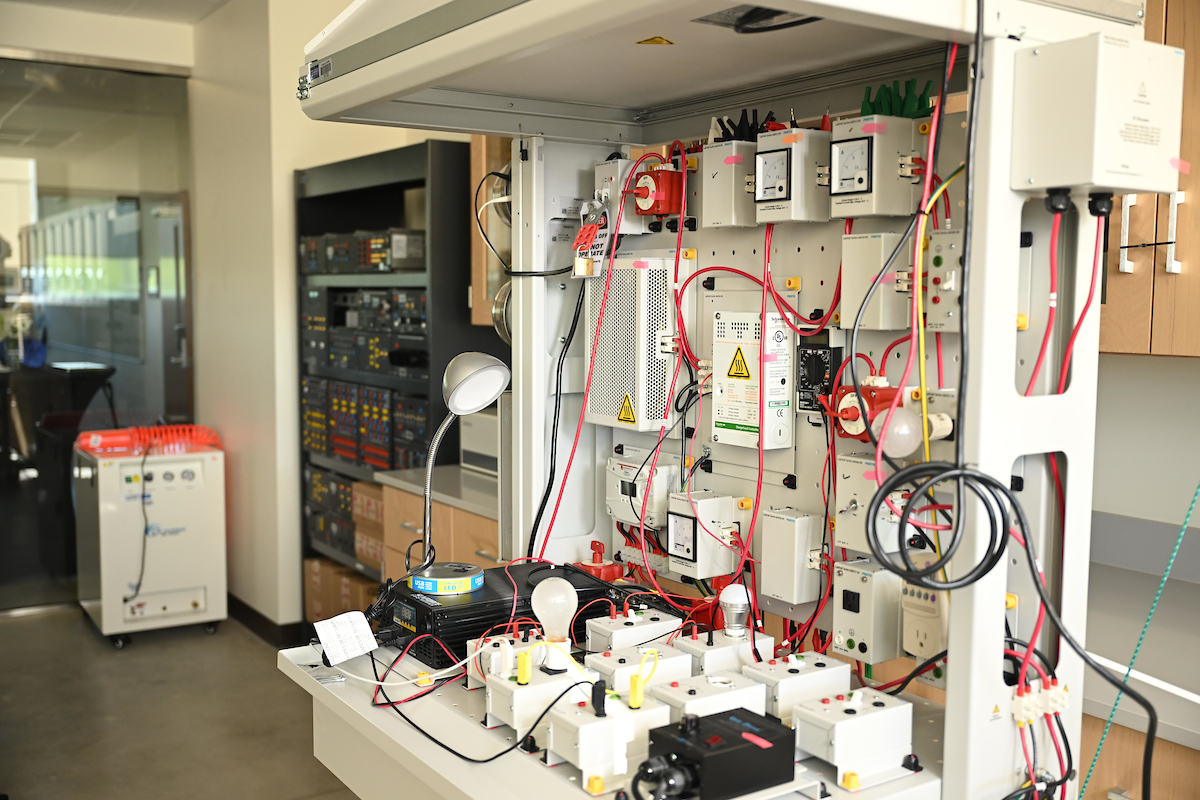
The ECECS Department provides undergraduate teaching and/or research laboratories in the following subjects: Electrical Measurements, Electronics, Power Electronics, Communications, Logic Circuits, Process Control & Instrumentation, Electromechanical Energy Conversion, Power System Analysis, Power System Protection, Computer Programming, Computer Interfacing, Computer Architecture, Computer Networks, Real Time Digital Signal Processing, Fundamentals of Digital Signal Processing, Automation Engineering, Robotic Engineering, and Plasma Engineering.
Student Organizations
Student Organizations
The students enrolled in the department may become members of any of the following organizations:
- IEEE Student Branch – This is an organization for undergraduates currently enrolled in electrical engineering programs. Branches are organized under the Institute of Electrical and Electronics Engineers, Inc., the world’s largest professional engineering society.
Degree Offered
Degree Offered
PUPR offers a Bachelor of Science in Electrical Engineering (BSEE) degree. In order to earn the BSEE degree, the student must complete the following requirements:
Minimum Graduation Requirements
15 Credit-hours in Mathematics
14 Credit-hours in Basic Sciences
21 Credit-hours in Socio-Humanistic Studies and Languages
12 Credit-hours in Engineering Sciences
52 Credit-hours in Basic Electrical Engineering Component
33 Credit-hours in Smart Grid Power Systems or Communications, Signals & Controls Systems Track Options
3 Credit-hours in Free Electives
150 Total Credit-hours
Electrical Engineering Curriculum
Electrical Engineering Curriculum
(150 Credit-Hours)
Mathematics Component
(15 Credit-Hours)
| Course | Title | Credit Hours |
|---|
| MATH 1350 | Calculus I | 4 |
| MATH 1360 | Calculus II | 4 |
| MATH 1370 | Calculus III | 4 |
| MATH 2350 | Differential Equations | 3 |
Basic Sciences Component
(14 Credit-Hours)
| Course | Title | Credit Hours |
|---|
| SCIE 1210 | Principles of Chemistry | 3 |
| SCIE 1211 | Principles of Chemistry Laboratory | 1 |
| SCIE 1430 | Physics I | 4 |
| SCIE 1431 | Physics I Laboratory | 1 |
| SCIE 1440 | Physics II | 4 |
| SCIE 1441 | Physics II Laboratory | 1 |
Socio-Humanistic Studies and Languages Component
(21 Credit-Hours)
| Course | Title | Credit Hours |
|---|
| ENGL 1020 | English Composition I | 3 |
| ENGL 1021 | English Composition II | 3 |
| ETH 2020 | Ethics in Engineering | 3 |
| ENGL 1026 | Fundamentals of Speech Communications | 3 |
| WOHI 2012 | World Civilization I | 3 |
| ELEC | General Education Humanities Elective | 3 |
| ELEC | General Education Social Sciences Elective | 3 |
Engineering Sciences Component
(12 Credit-Hours)
| Course | Title | Credit Hours |
|---|
| ENGI 2260 | Engineering Economics | 3 |
| ENGI 2270 | Engineering Probability & Statistics | 3 |
| ENGI 2910 | Engineering Mechanics, Statics & Dynamics | 3 |
| ENGI 3440 | Thermo-Fluids | 3 |
Electrical Engineering Basic Core Component
(52 Credit-Hours)
| Course | Title | Credit Hours |
|---|
| CECS 2200 | Computer Programming Fundamentals | 1 |
| CECS 2202 | Computer Programming I | 4 |
| CECS 2203 | Computer Programming I Laboratory | 0 |
| COE 2300 | Logic Circuits | 3 |
| COE 2301 | Logic Circuits Laboratory | 1 |
| EE 1130 | Freshman Design for Electrical & Computer Engineers | 3 |
| EE 2000 | Circuit Analysis I | 3 |
| EE 2001 | Electrical Measurements Laboratory | 1 |
| EE 2010 | Computational Methods in Electrical & Computer Engineering | 3 |
| EE 2020 | Circuit Analysis II | 3 |
| EE 2030 | Electromagnetics Theory | 3 |
| EE 2402 | Electromechanical Energy Conversion | 3 |
| EE 2403 | Electromechanical Energy Conversion Laboratory | 1 |
| EE 2500 | Electronics I | 3 |
| EE 2501 | Electronics I Laboratory | 1 |
| EE 3002 | Signals & Systems | 3 |
| EE 3600 | Automatic Controls | 3 |
| EE 3610 | Automation Engineering | 3 |
| EE 3611 | Automation Engineering Laboratory | 1 |
| EE 4220 | Fundamentals of Software Processes, Databases, and Networking | 3 |
| EE 4002 | Capstone Design Course I | 3 |
| EE 4022 | Capstone Design Course II | 3 |
Free Electives
(3 Credit-Hours)
Select any three credit-hours, except electrical engineering courses offered as service course for non-electrical engineering students.
Program Electives Component
Communications, Signals & Controls Systems Area of Interest
(Must take 33 Credit-Hours)
Must select 11 credit-hours in required area courses in the “Communications, Signals & Controls Systems Area of Interest”, and other 22 credit-hours in elective area courses. CECS courses will also be available as department electives. Of the program electives, a total of 14 credit-hours must be in EE or COE 4th year level, or CECS 3rd year level. No CS courses will be accepted. At least two credit-hours, or their equivalent in laboratory experience must be included. Elective courses must amount to at least eight credit-hours of design.
Required Area Courses
(Must take 11 Credit-Hours)
| Course | Title | Credit-Hours |
|---|
| COE 3320 | Microprocessors | 3 |
| COE 3321 | Microprocessors Laboratory | 1 |
| EE 3510 | Electronics II | 3 |
| EE 3511 | Electronics II Laboratory | 1 |
| EE 3702 | Fundamentals of Wireless Communications and Cellular Networks | 3 |
(*)Technical Elective Course: any Civil Engineering (CE) elective course; or any Civil and Environmental Engineering (CEE) elective course; or an Environmental Engineering (ENVE) course approved by the Department Head; or a Land Surveying (SURV) course approved by the Department Head; or a Geomatic Science (GEOM) course approved by the Department Head; or any of the following General Engineering courses: ENGI 2320-Principles of Electrical Engineering, ENGI 2430-Engineering Thermodynamics, or ENGI 3510-Engineering Materials; or a technical course approved by the Department Head. Those students enrolled in the Combined Bachelor’s-Master’s Degree Program may take a graduate-level course as a Technical Elective Course with the approval of the Department Head
Elective Area Courses
(Must take 22 credits, at least 14 credits in EE 4XXX or CECS 3XXX Level Courses)
| Course | Title | Credit-Hours |
|---|
| CECS 3216 | Machine Learning | 3 |
| CECS 3218 | Data Engineering for Machine Learning I | 3 |
| CECS 3234 | UNIX Operating System | 3 |
| CECS 3302 | Data Communications | 3 |
| CECS 4224 | Deep Learning | 3 |
| CECS 4232 | Data Engineering for Machine Learning II | 3 |
| CECS 4240 | Real-Time Operating Systems | 3 |
| COE 3302 | Digital System Design with VHDL | 3 |
| COE 3303 | Digital Systems Design with VHDL Laboratory | 1 |
| COE 4340 | Microcomputer Interfacing | 4 |
| COE 4341 | Microcomputer Interfacing Laboratory | 0 |
| COOP 3010 | Professional Practice | 3 |
| EE 3220 | Software Applications for Electrical Engineering | 3 |
| EE 3412 | Electric Machines Control | 3 |
| EE 3413 | Electric Machines Control Laboratory | 1 |
| EE 3512 | Power Electronics | 3 |
| EE 3513 | Power Electronics Laboratory | 1 |
| EE 3710 | Random Processes | 3 |
| EE 4010 | Electromagnetics Theory II | 3 |
| EE 4030 | Electromagnetic Compatibility (EMC/EMI) | 3 |
| EE 4031 | Electromagnetic Compatibility (EMC/EMI) Laboratory | 1 |
| EE 4602 | Process Control & Instrumentation | 3 |
| EE 4603 | Process Control & Instrumentation Laboratory | 1 |
| EE 4606 | Digital Control Systems | 3 |
| EE 4612 | Control System Design | 3 |
| EE 4620 | Robotic Engineering Design | 4 |
| EE 4621 | Robotic Engineering Design Laboratory | 0 |
| EE 4622 | Industrial Automation | 3 |
| EE 4640 | Avionics Systems | 3 |
| EE 4706 | Fiber Optics System Design | 3 |
| EE 4720 | Digital Signal Processing | 3 |
| EE 4724 | Digital Data Transmission Systems | 3 |
| EE 4736 | Communication Systems, Simulation & Design | 3 |
| EE 4742 | Advanced Mobile Networks and Technologies | 3 |
| EE 4902 | Undergraduate Research in Electrical Engineering | 3 |
| EE 4904 | Undergraduate Research in Electrical Engineering II | 3 |
| EE 4911 | Electrical Engineering Seminar I | 1 |
| EE 4912 | Electrical Engineering Seminar II | 1 |
| EE 4990/4991 | Special Topics in Electrical Engineering | 3 |
| MATH 2360 | Linear Algebra | 3 |
Note: Availability of courses EE 4902, EE 4904 and EE 4990, EE 4991, as well as CS 4990, and COE 4990 for the Electrical Engineering Program students, will be determined by the department head, depending on the specific teaching or research topic.
Program Electives Component
Smart Grid Power Systems Area of Interest
(Must take 33 Credit-Hours)
Must select 24 credit-hours in required area courses in the “Smart Grid Power Systems Area of Interest”, and other nine credit-hours in elective area courses. CECS courses will also be available as department electives. Of the program electives area courses, a total of 14 credit-hours must be in courses EE or COE 4th year level. No CS courses will be accepted. At least two credit-hours, or their equivalent in laboratory experience must be included. Elective courses must include at least eight credit-hours of design.
Required Area Courses
(Must take 24 Credit-Hours)
| Course | Title | Credit-Hours |
|---|
| EE 3412 | Electric Machines Control | 3 |
| EE 3413 | Electric Machines Control Laboratory | 1 |
| EE 3420 | Power Systems Analysis I | 3 |
| EE 3440 | Electric System Design I | 3 |
| EE 3512 | Power Electronics | 3 |
| EE 3513 | Power Electronics Laboratory | 1 |
| EE 4400 | Power Systems Analysis II | 3 |
| EE 4401 | Power Systems Analysis Laboratory | 1 |
| EE 4438 | Smart Distribution Systems Engineering | 3 |
| EE 4452 | Alternative Generation Systems | 3 |
Elective Area Courses
(Must take nine credits, at least four credits in EE 4XXX Level Courses)
| Course | Title | Credit-Hours |
|---|
| COOP 3010 | Professional Practice | 3 |
| EE 3220 | Software Applications for Electrical Engineering | 3 |
| EE 4422 | Electric Power Quality | 3 |
| EE 4432 | Power System Protection | 3 |
| EE 4433 | Power System Protection Laboratory | 1 |
| EE 4442 | Lighting Fundamentals Design | 3 |
| EE 4444 | Electric System Design II | 3 |
| EE 4462 | Electrical Construction Project Management | 3 |
| EE 4464 | Generation Control Systems | 3 |
| EE 4466 | Renewable Energy Systems | 3 |
| EE 4602 | Process Control & Instrumentation | 3 |
| EE 4603 | Process Control & Instrumentation Laboratory | 1 |
| EE 4622 | Industrial Automation | 3 |
| EE 4902 | Undergraduate Research in Electrical Engineering | 3 |
| EE 4904 | Undergraduate Research in Electrical Engineering II | 3 |
| EE 4911 | Electrical Engineering Seminar I | 1 |
| EE 4912 | Electrical Engineering Seminar II | 1 |
| EE 4990/4991 | Special Topics in Electrical Engineering | 3 |
Note: Availability of courses EE 4902, EE 4904 and EE 4990, EE 4991, as well as CS 4990, and COE 4990 for the Electrical Engineering Program students, will be determined by the department head, depending on the specific teaching or research topic.
Electrical Engineering Program Curriculum Sequence
Electrical Engineering Program Curriculum Sequence
(150 Credit-Hours)
First Year
First Quarter
| Course | Title | Credit-Hours |
|---|
| MATH 1350 | Calculus I | 4 |
| ENGL 1020 | English Composition I | 3 |
| WOHI 2012 | World Civilization I | 3 |
| EE 1130 | Freshman Design for Electrical & Computer Engineers | 3 |
| Total | 13 |
1st Year – Second Quarter
| Course | Title | Credit-Hours |
|---|
| MATH 1360 | Calculus II | 4 |
| SCIE 1430 | Physics I | 4 |
| SCIE 1431 | Physics I Laboratory | 1 |
| SCIE 1210 | Principles of Chemistry | 3 |
| SCIE 1211 | Principles of Chemistry Laboratory | 1 |
| Total | 13 |
1st Year – Third Quarter
| Course | Title | Credit-Hours |
|---|
| MATH 1370 | Calculus III | 4 |
| SCIE 1440 | Physics II | 4 |
| SCIE 1441 | Physics II Laboratory | 1 |
| CECS 2200 | Computer Programming Fundamentals | 1 |
| ENGI 2270 | Engineering Probability & Statistics | 3 |
| Total | 13 |
Second Year
First Quarter
| Course | Title | Credit-Hours |
|---|
| MATH 2350 | Differential Equations | 3 |
| EE 2000 | Circuit Analysis | 3 |
| EE 2030 | Electromagnetics Theory | 3 |
| CECS 2202 | Computer Programming I | 4 |
| CECS 2203 | Computer Programming I Laboratory | 0 |
| Total | 13 |
2nd Year – Second Quarter
| Course | Title | Credit-Hours |
|---|
| COE 2300 | Logic Circuits | 3 |
| COE 2301 | Logic Circuits Laboratory | 1 |
| EE 2001 | Electrical Measurements Laboratory | 1 |
| EE 2020 | Circuit Analysis II | 3 |
| EE 2402 | Electromechanical Energy Conversion | 3 |
| Total | 11 |
(Only for Students in Smart Grid Power Systems Area of Interest)
2nd Year – Third Quarter
| Course | Title | Credit-Hours |
|---|
| EE 2010 | Computational Methods in Electrical & Computer Engineering | 3 |
| EE 2403 | Electromechanical Energy Conversion Laboratory | 1 |
| EE 2500 | Electronics I | 3 |
| EE 2501 | Electronics I Laboratory | 1 |
| EE 3412 | Electric Machines Control | 3 |
| EE 3420 | Power Systems Analysis I | 3 |
| Total | 14 |
Third Year
First Quarter
| Course | Title | Credit-Hours |
|---|
| EE 3413 | Electric Machines Control Laboratory | 1 |
| EE 3512 | Power Electronics | 3 |
| EE 3513 | Power Electronics Laboratory | 1 |
| EE 3610 | Automation Engineering | 3 |
| EE 3611 | Automation Engineering Laboratory | 1 |
| EE 4220 | Fundamentals of Software Processes, Databases & Networking | 3 |
| Total | 12 |
3rd Year – Second Quarter
| Course | Title | Credit-Hours |
|---|
| EE 3002 | Signals & Systems | 3 |
| EE 3440 | Electric System Design I | 3 |
| ENGI 2260 | Engineering Economics | 3 |
| ENGL 1021 | English Composition II | 3 |
| Total | 12 |
3rd Year – Third Quarter
| Course | Title | Credit-Hours |
|---|
| EE 3600 | Automatic Controls | 3 |
| EE 4400 | Power Systems Analysis II | 3 |
| EE 4401 | Power Systems Analysis Laboratory | 1 |
| EE 4438 | Smart Distribution Systems Engineering | 3 |
| ETH 2020 | Ethics in Engineering | 3 |
| Total | 13 |
Fourth Year
First Quarter
| Course | Title | Credit-Hours |
|---|
| EE 4452 | Alternative Generation Systems | 3 |
| ENGI 2910 | Engineering Mechanics, Statics & Dynamics | 3 |
| ENGL 1026 | Fundamentals of Speech Communications | 3 |
| ELEC | General Education Humanities Elective | 3 |
| Total | 12 |
4th Year – Second Quarter
| Course | Title | Credit-Hours |
|---|
| EE 4002 | Capstone Design Course I | 3 |
| ENGI 3440 | Thermo-Fluids | 3 |
| EE ELEC | EE Smart Grid Power Technical Electives | 6 |
| Total | 12 |
4th Year – Third Quarter
| Course | Title | Credit-Hours |
|---|
| EE 4022 | Capstone Design Course II | 3 |
| EE ELEC | EE Smart Grid Power Technical Electives | 3 |
| ELEC | General Education Social Science Elective | 3 |
| ELEC | Free Elective | 3 |
| Total | 12 |
(Only for Students in Communications, Signals & Controls Systems Area of Interest)
2nd Year – Third Quarter
| Course | Title | Credit-Hours |
|---|
| EE 2010 | Computational Methods in Electrical & Computer Engineering | 3 |
| EE 2403 | Electromechanical Energy Conversion Laboratory | 1 |
| EE 2500 | Electronics I | 3 |
| EE 2501 | Electronics I Laboratory | 1 |
| ENGI 2910 | Engineering Mechanics, Statics & Dynamics | 3 |
| Total | 11 |
Third Year
First Quarter
| Course | Title | Credit-Hours |
|---|
| COE 3320 | Microprocessors | 3 |
| COE 3321 | Microprocessors Laboratory | 1 |
| EE 3510 | Electronics II | 3 |
| EE 3511 | Electronics II Laboratory | 1 |
| EE 4220 | Fundamentals of Software Processes, Databases & Networking | 3 |
| ENGL 1021 | English Composition II | 3 |
| Total | 14 |
3rd Year – Second Quarter
| Course | Title | Credit-Hours |
|---|
| EE 3002 | Signals & Systems | 3 |
| EE 3610 | Automation Engineering | 3 |
| EE 3611 | Automation Engineering Laboratory | 1 |
| EE 3702 | Fundamentals of Wireless Communications and Cellular Networks | 3 |
| ETH 2020 | Ethics in Engineering | 3 |
| Total | 13 |
3rd Year – Third Quarter
| Course | Title | Credit-Hours |
|---|
| EE 3600 | Automatic Controls | 3 |
| EE ELEC | EE Communications, Signals & Controls Technical Electives | 4 |
| ENGI 2260 | Engineering Economics | 3 |
| ENGL 1026 | Fundamentals of Speech Communications | 3 |
| Total | 13 |
Fourth Year
First Quarter
| Course | Title | Credit-Hours |
|---|
| EE ELEC | EE Communications, Signals & Controls Technical Electives | 9 |
| ELEC | General Education Humanities Elective | 3 |
| Total | 12 |
4th Year – Second Quarter
| Course | Title | Credit-Hours |
|---|
| EE 4002 | Capstone Design Course I | 3 |
| EE ELEC | EE Communications, Signals & Controls Technical Electives | 6 |
| ENGI 3440 | Thermo-Fluids | 3 |
| Total | 12 |
4th Year – Third Quarter
| Course | Title | Credit-Hours |
|---|
| EE 4022 | Capstone Design Course II | 3 |
| EE ELEC | EE Communications, Signals & Controls Technical Electives | 3 |
| ELEC | General Education Social Science Elective | 3 |
| ELEC | Free Elective | 3 |
| Total | 12 |
Program Courses
Program Courses
Computer Engineering and Computer Science Courses
(Go to the ECECS Department Courses for the Description)
CECS 2200 Computer Programming Fundamentals
CECS 2202 Computer Programming I
CECS 2203 Computer Programming I Laboratory
CECS 3216 Machine Learning
CECS 3218 Data Engineering for Machine Learning I
CECS 3234 UNIX Operating System
CECS 3302 Data Communications
CECS 4224 Deep Learning
CECS 4232 Data Engineering for Machine Learning II
CECS 4240 Real-Time Operating Systems
Computer Engineering Courses
(Go to the ECECS Department Courses for the Description)
COE 2300 Logic Circuits
COE 2301 Logic Circuits Laboratory
COE 3302 Digital System Design with VHDL
COE 3303 Digital Systems Design with VHDL Laboratory
COE 3320 Microprocessors
COE 3321 Microprocessors Laboratory
COE 4330 Computer Networks
COE 4331 Computer Networks Laboratory
COE 4340 Microcomputer Interfacing
COE 4341 Microcomputer Interfacing Laboratory
Electrical Engineering Courses
(Go to the ECECS Department Courses for the Description)
EE 1130 Freshman Design for Electrical & Computer Engineers
EE 2000 Circuit Analysis I
EE 2001 Electrical Measurements Laboratory
EE 2010 Computational Methods in Electrical & Computer Engineering
EE 2020 Circuit Analysis II
EE 2030 Electromagnetics Theory
EE 2402 Electromechanical Energy Conversion
EE 2403 Electromechanical Energy Conversion Laboratory
EE 2500 Electronics I
EE 2501 Electronics I Laboratory
EE 3002 Signals & Systems
EE 3220 Software Applications for Electrical Engineering
EE 3412 Electric Machines Control
EE 3413 Electric Machines Control Laboratory
EE 3420 Power Systems Analysis I
EE 3440 Electric System Design I
EE 3510 Electronics II
EE 3511 Electronics II Laboratory
EE 3512 Power Electronics
EE 3513 Power Electronics Laboratory
EE 3600 Automatic Controls
EE 3610 Automation Engineering
EE 3611 Automation Engineering Laboratory
EE 3702 Fundamentals of Wireless Communications & Cellular Networks
EE 3710 Random Processes
EE 4002 Capstone Design Course I
EE 4010 Electromagnetics Theory II
EE 4022 Capstone Design Course II
EE 4030 Electromagnetic Compatibility (EMC/EMI)
EE 4031 Electromagnetic Compatibility (EMC/EMI) Laboratory
EE 4220 Fundamentals of Software Processes, Databases, and Networking
EE 4400 Power Systems Analysis II
EE 4401 Power Systems Analysis Laboratory
EE 4422 Electric Power Quality
EE 4432 Power System Protection
EE 4433 Power System Protection Laboratory
EE 4438 Smart Distribution Systems Engineering
EE 4442 Lighting Fundamentals Design
EE 4444 Electric System Design II
EE 4462 Electrical Construction Project Management
EE 4464 Generation Control Systems
EE 4466 Renewable Energy Systems
EE 4602 Process Control & Instrumentation
EE 4603 Process Control & Instrumentation Laboratory
EE 4606 Digital Control Systems
EE 4612 Control System Design
EE 4620 Robotic Engineering Design
EE 4621 Robotic Engineering Design Laboratory
EE 4622 Industrial Automation
EE 4640 Avionics Systems
EE 4706 Fiber Optics System Design
EE 4720 Digital Signal Processing
EE 4724 Digital Data Transmission Systems
EE 4736 Communication Systems, Simulation & Design
EE 4742 Advanced Mobile Networks and Technologies
EE 4902 Undergraduate Research in Electrical Engineering
EE 4904 Undergraduate Research in Electrical Engineering II
EE 4911 Electrical Engineering Seminar I
EE 4912 Electrical Engineering Seminar II
EE 4990/4991 Special Topics in Electrical Engineering
Other Department Courses
(Go to the Mathematics and Sciences Department Courses for the Description)
MATH 2360 Linear Algebra



 News



 Events